If you own or run the finance side of a creator agency, this is how creator agencies calculate commission on creator earnings: multiply the agreed percentage by a commission base that the management agreement defines. The percentage is the number everyone negotiates. The base is the number that causes disputes, because "30% of earnings" can mean 30% of what fans paid, 30% of what the creator actually received, or 30% of what was left after refunds. This guide shows where each base starts, which deductions come off before the percentage, and what to write down so the math gives the same answer every period.
The short answer: a percentage times a base the agreement defines
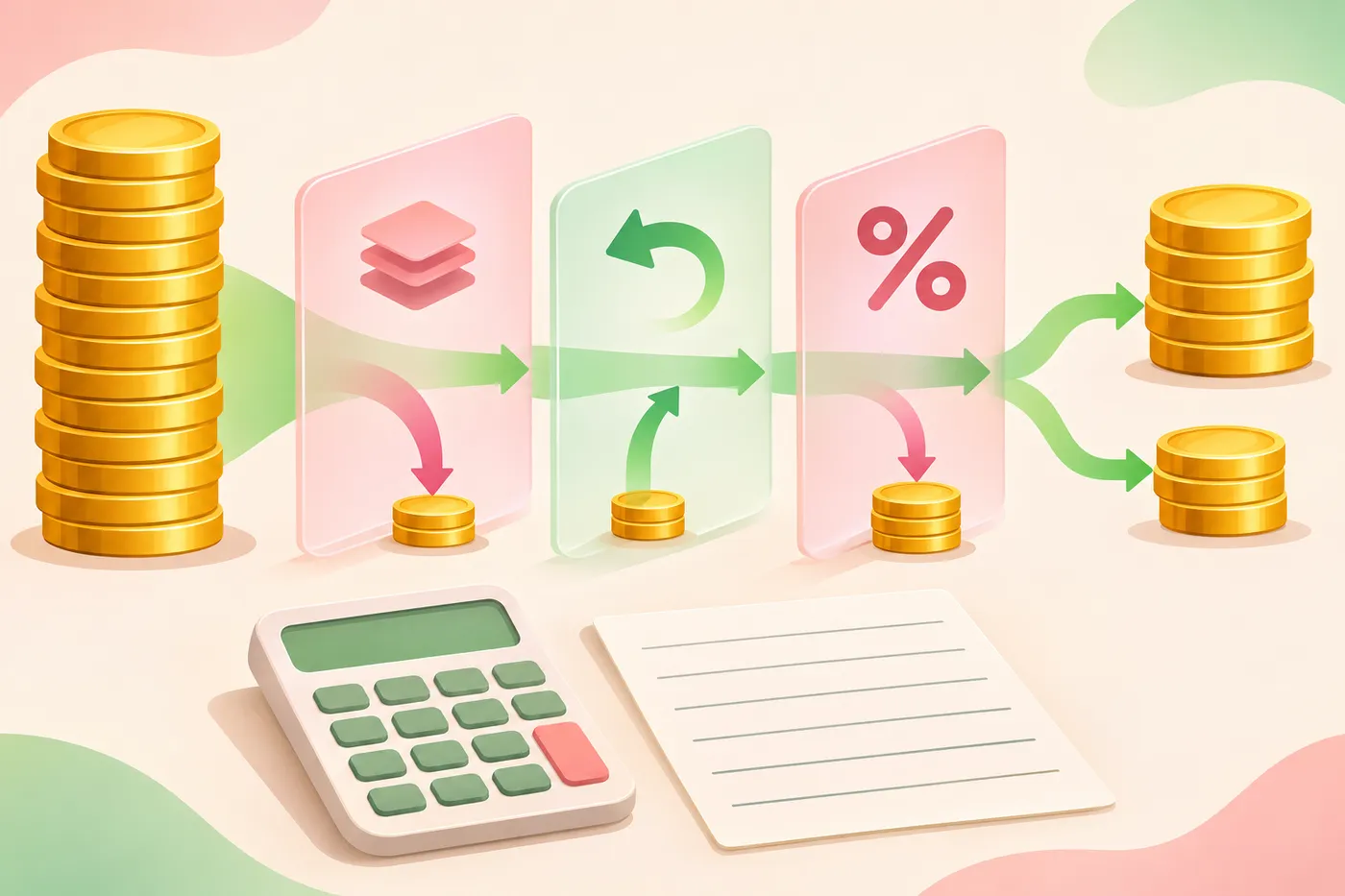
Commission for a period equals the agreed percentage multiplied by the commission base for that period. Work through the base in the same order every time:
- Start with what fans, subscribers or advertisers paid during the period (gross).
- Subtract what the platform keeps as its fee or revenue share.
- Subtract refunds, chargebacks and reversals that landed in the period, if the agreement counts them.
- Subtract any other deduction the agreement names, such as payment processing or payout fees charged to the creator.
- Apply the agreed percentage to what remains. That is the agency's commission.
- Pay any referral partner, account manager or chat team share out of the agency's commission, not out of the creator's base.
Steps 2 to 4 are where agencies and creators most often disagree, so the rest of this guide walks through them.
Gross vs net: where the commission base starts
Gross is the total the audience paid. Net is what the creator actually receives after the platform takes its cut. Many creators never see the true gross figure, because the platform deducts its share before anything reaches their dashboard. YouTube, for example, says it pays partners 55% of net revenues from ads on their public videos, so the figure a creator sees is already after YouTube's share. Patreon's pricing page lists a platform fee on the income a creator earns there, plus payment processing, currency conversion and payout fees.
Because each platform reports money differently, "gross" and "net" are not precise enough on their own. Tie the base to a specific figure the creator can see, such as the earnings total on a named platform dashboard or the amount that lands in the creator's connected account.
Worked example: same percentage, different base
These numbers are illustrative, not any platform's actual rates. Say fans pay $10,000 in a month on a platform that keeps 20%, so the creator receives $8,000, and the agency's rate is 30%.
- 30% of gross: $10,000 x 30% = $3,000 to the agency. The creator keeps $5,000 of the $8,000 they received.
- 30% of net: $8,000 x 30% = $2,400 to the agency. The creator keeps $5,600.
- The difference is $600 a month. Measured against what the creator actually received, a 30% gross rate works out to 37.5% of net ($3,000 / $8,000).
Neither base is wrong. The problem is an agreement that does not say which one applies, so each side reads it the way that suits them.
Which deductions come off before the percentage
List every deduction in the agreement, and list what does not come off as well. These are the items agencies most often need to decide:
- Platform fee or revenue share: comes off in a net agreement. Name the platform and the figure you will use.
- Payment processing, currency conversion and payout fees: say whether the creator's base is before or after them.
- Sales tax or VAT the platform collects: say whether any tax collected on a sale is included in or left out of the base.
- Refunds, chargebacks and reversals: decide whether they reduce the base, and in which period (see the next section).
- The agency's own costs, such as staff or ad spend: say whether they come out of the agency's commission or the creator's base, and get both sides to agree in writing.
Refunds and chargebacks: reduce the base in the period they land
A refund or chargeback can arrive weeks after the sale it reverses. You can handle it two ways. You can reduce the base in the period the reversal is reported, which keeps closed periods closed. Or you can go back and recalculate the original period, which is more precise but reopens invoices and payouts you have already settled.
The first approach is simpler to run: the reversal reduces the current period's base, and if it makes the base negative, the shortfall carries forward to the next period instead of turning into a separate bill. Write the rule down either way. If the money has already been paid out, our guide on how creator agencies handle refunds and chargebacks after a payout covers how to record and recover it.
Earned, cleared or paid out: which date puts money in the base
The same dollar can count in different periods depending on which date you use. Earnings often show on a platform dashboard before the funds have cleared, and a creator may withdraw days or weeks later. Pick one of these and use it every period:
- Earned date: commission counts when the platform records the sale. This matches the creator's dashboard but includes money that may still be reversed.
- Cleared date: commission counts once the funds have settled. Fewer reversals, but a short delay.
- Paid-out date: commission counts when the money reaches the creator's account. This is the simplest to verify against a bank statement.
Also set a start date. Earnings from before the agreement's effective date should stay outside the base, and the agreement should say so.
Tiered rates, minimums and caps
If your rate changes with volume, for example a lower percentage above a monthly threshold, state which base the threshold is measured on. A threshold on gross is reached sooner than the same threshold on net. Also say whether the higher tier applies to the whole base or only to the amount above the threshold, and whether any minimum monthly fee or cap is measured before or after refunds.
What to write in the management agreement
A management agreement that answers these points leaves little room for a different reading later. Our practical guide to creator revenue splits covers the wider agreement; for the commission calculation, make sure it states:
- The percentage, and the date it takes effect.
- The base, named as gross or net, and the exact figure it comes from on each covered platform.
- Every covered revenue source, and how a new source gets added.
- Each deduction that comes off before the percentage, and the ones that do not.
- How refunds, chargebacks and reversals are handled, and in which period.
- Whether earnings count on the earned, cleared or paid-out date, and the length of each period.
- How tiers, minimums or caps are measured, if you use them.
- That shares for referral partners, account managers or chat teams are paid from the agency's commission.
- How a rate change is agreed and when it starts to apply.
How Melon applies the agreed math
Melon does not replace the business agreement. It automates payment activity based on the terms the agency and creator already agreed to. In Melon, a split is the agreement that defines the percentage of covered creator earnings shared with the agency, and each agreement record keeps the percentage, effective date, creator and revenue source together.
For connected revenue sources, Melon matches each revenue event to the agreement, calculates the agreed agency share and creates a traceable charge or invoice. Each amount is matched to the creator, the earnings period and the split rule, so agencies and creators see the same earnings, invoice, cash-out and payment history. Cleared activity is grouped into one weekly agency payout, and pending activity stays visible in the dashboard. See how this works on the Melon for agencies page, or how the payout routine runs on the automated creator payouts page.
See how Melon works for agencies
Frequently asked questions
Do creator agencies take commission on gross or net earnings?
Either, depending on the management agreement. Net means the percentage applies after the platform's fee, which leaves the creator more. A percentage on gross is effectively a higher rate. The agreement should name the base and the exact figure it comes from.
What is a split?
A split is the agreement that defines the percentage of covered creator earnings shared with an agency in exchange for services.
Does Melon replace the business agreement?
No. Melon automates payment activity based on the terms the agency and creator already agreed to.
When are agencies paid?
Agency payouts are grouped on a weekly schedule after funds have cleared. Pending activity remains visible in the dashboard.